
KiNDD / NDD Resource Navigator
KiNDD / NDD Resource Navigator is a founder-led nonprofit startup project helping families navigate developmental disability services in Los Angeles County.
The project began as a commissioned web mapping platform and evolved into a broader care-navigation product: a live web map at kinddhelp.org, an iOS app published as NDD Resources / KiNDD, a Django/PostGIS backend, and AI-assisted guidance for families.
Problem
Families looking for developmental disability services often have to connect several fragmented pieces of information:
- Which Regional Center serves their ZIP code
- Which providers serve that geography
- Which therapy types, age groups, diagnoses, and payment paths are relevant
- How to contact or navigate to the right provider
- What next steps are appropriate without turning navigation into medical, legal, or eligibility advice
The core product idea is place-based service navigation:
family location -> ZIP code -> Regional Center assignment -> relevant providers and guidance
That model makes the product more than a provider directory. It maps the real service system families have to navigate.
What I Built
I led the technical build from early web-map infrastructure into a multi-surface product:
- Founder/engineer product direction: helped shape the project from a commissioned website into a nonprofit startup platform.
- Live web map: Vue 3, Vite, Mapbox, responsive provider search, Regional Center boundaries, and directions.
- Backend API: Django 5.2, Django REST Framework, PostgreSQL/PostGIS, geographic search, provider data, Regional Center logic, and API contracts.
- iOS app: SwiftUI app experience with provider discovery, Regional Center navigation, map/list flows, location-aware search, and bilingual support.
- AI assistance: Bedrock-backed chat, streaming responses, tool-based navigation, provider retrieval, image/document analysis paths, and English/Spanish interaction patterns.
- Research RAG: separate public-source NDD research assistant using Cohere embeddings and Pinecone namespaces for cited research answers.
- Operations: AWS deployment, GitHub Actions, DNS/SSL/CDN setup, data import workflows, SEO work, and stakeholder handoff documentation.
Public Product Surface
The family-facing product includes:
- Interactive map of LA County developmental disability resources
- All 7 LA County Regional Centers in public materials
- ZIP-code and location-based Regional Center matching
- 370+ verified providers/resources in the current public positioning
- Smart search by therapy type, insurance, age group, diagnosis, and location
- Turn-by-turn directions and provider contact actions
- English and Spanish support
- AI assistant responses in the user’s preferred language
- No required registration or subscription for public use
Architecture
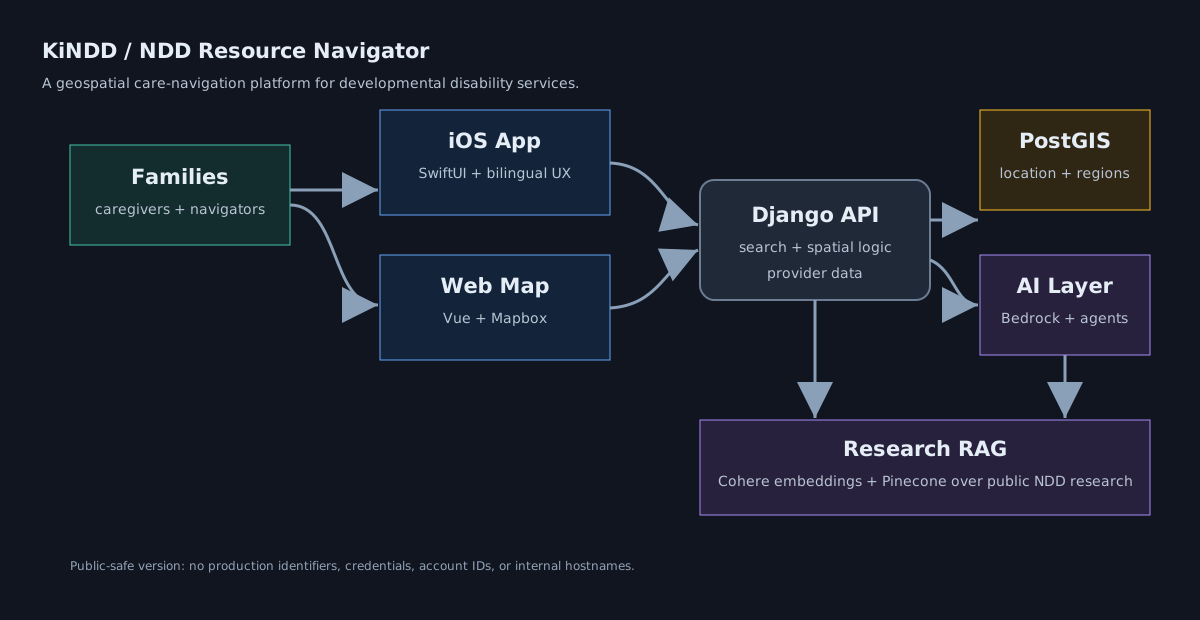
The platform has three main layers.
Geospatial Data Layer
PostgreSQL/PostGIS models the core service-navigation logic: provider locations, Regional Center service areas, ZIP-code assignment, proximity search, and map-ready boundary data.
This layer answers questions like:
- Which Regional Center serves this ZIP code?
- Which providers are relevant to this family based on geography?
- How far away are the available resources?
- What service areas should appear on the map?
Product Surfaces
The product ships through two user-facing surfaces:
- A web mapping experience at kinddhelp.org
- A SwiftUI iOS app published as NDD Resources / KiNDD
Both surfaces share the same core API and service-navigation model.
AI / RAG Layer
The AI layer has two adjacent paths:
- Family navigation assistance: Bedrock-backed chat and agent flows over provider, Regional Center, document, image, and structured context.
- Research RAG: Cohere embeddings and Pinecone vector search over public or permitted NDD research sources, with citation-aware answers and a source policy for controlled-access data.
The AI is intentionally framed as guided support over trusted data, not diagnosis, treatment advice, legal advice, eligibility determination, or a replacement for public-service staff.
Engineering Lessons
The most important engineering lesson was that the map, data model, and AI layer have to agree on the same domain truth.
For KiNDD, the central invariant is:
Regional Center assignment is geographic.
That invariant affects API design, UI copy, filtering, search, AI prompts, and stakeholder education. If Regional Centers are mistakenly treated like insurance plans or optional filters, the product becomes misleading. If they are treated as service-area geography, the system becomes much more useful.
Other lessons:
- Geospatial products need source-of-truth location logic, not scattered nearest-point heuristics.
- Provider search is not just keyword search; it depends on age, service type, insurance/funding context, diagnosis, geography, and data freshness.
- AI is most useful when it reduces cognitive load without overclaiming.
- Public health-adjacent AI needs careful scope, disclaimers, and review paths.
- Founder/engineer work is not just code: it includes public positioning, operations, stakeholder handoff, nonprofit structure, and data governance.
Related Articles
- Building A Geospatial Care-Navigation Platform For Developmental Disability Services
- Designing AI Assistance For A Public-Interest Healthcare Navigator
- From Commissioned Website To Nonprofit Startup: The KiNDD Technical Journey
Stack
Backend: Python, Django, Django REST Framework, PostgreSQL, PostGIS
Web: Vue 3, Vite, TypeScript, Mapbox
Mobile: SwiftUI, MapKit, iOS localization
AI: AWS Bedrock, Claude, Titan embeddings, Strands agents, Cohere embeddings, Pinecone
Infrastructure: AWS, Elastic Beanstalk, S3, CloudFront, Route 53, GitHub Actions
Product: service navigation, provider search, Regional Center mapping, bilingual support, public-source research RAG